EcoFlow DELTA 3 Plus Portable Power Station Review
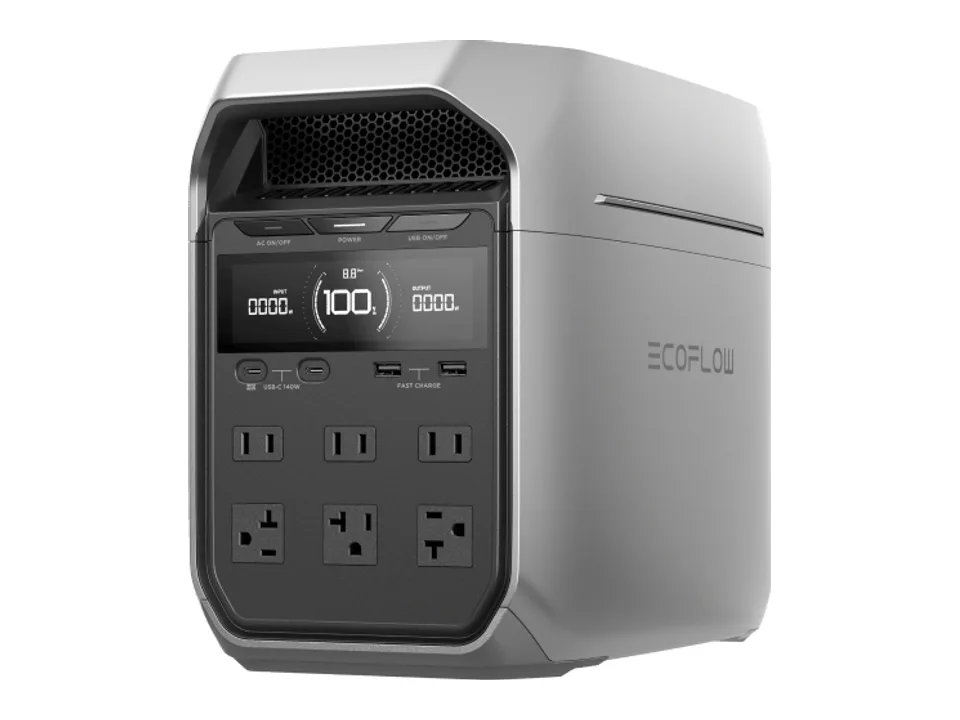
A 1,024 Wh LiFePO4 station with 1,800 W of AC output, a 56-minute wall recharge, 1,000 W of solar input and room to grow to 5 kWh.
By Watt Versus Editorial· Updated
This page was drafted with AI assistance from manufacturers' specs and manuals, and is checked by our editor.
Our verdict
The most complete 1 kWh station we cover: fast to recharge, strong on solar, and expandable when you need more. Pick it unless weight or a lower budget matters more.
Pros and cons
Pros
- 4,000-cycle LFP rating, a step up from the DELTA 2's 3,000
- Full recharge from a wall outlet in 56 minutes, by EcoFlow's figures
- 1,000 W of solar input, double the DELTA 2
- Two 140 W USB-C ports charge most laptops at full speed
Cons
- At 27.6 lb it is heavier than the Jackery Explorer 1000 v2 and Anker SOLIX C1000 Gen 2
- Reaching 5 kWh needs extra batteries, sold separately
- X-Boost runs high-wattage heaters and kettles at reduced power, not at their full rating
Specifications
| Capacity | 1,024 Wh |
|---|---|
| Battery chemistry | LiFePO4 (LFP) |
| Rated cycle life | 4,000 cycles to 80% capacity |
| AC output | 1,800 W (2,200 W with X-Boost) |
| Peak output | 3,600 W surge |
| AC outlets | 6 (US model) |
| USB-C output | 2 x 140 W |
| Wall recharge | 0-100% in 56 minutes (1,500 W AC input) |
| Max solar input | 1,000 W (2 x 500 W MPPT) |
| Expandable to | About 5 kWh with DELTA 3, DELTA 2 or DELTA 2 Max extra batteries |
| Backup switchover | Under 10 ms |
| Weight | 27.6 lb (12.5 kg) |
| Dimensions | 15.7 x 8 x 11.2 in |
| Warranty | 5 years |
The full review
Who it suits
Campers, RV owners and households that want a 1 kWh station today and the option to add capacity later. The 1,000 W solar input means two or three rooftop or folding panels can refill it in a day of good sun.
Who should skip it
Anyone who mainly needs something light to carry to a campsite: the Jackery Explorer 1000 v2 is about 4 lb lighter. If you will never add a battery or solar, the expansion port and the high solar limit are features you pay for and do not use.
What we could not confirm
EcoFlow's US page shows six AC outlets, while its European and Australian pages list four, because regional models differ. We list the US count. One EcoFlow FAQ gives a much higher weight than the product page and manual; we use the product page figure.
Frequently asked questions
- How long does the EcoFlow DELTA 3 Plus take to charge?
- EcoFlow rates it at 0-100% in 56 minutes from a wall outlet with 1,500 W of AC input, and about 70 minutes from 1,000 W of solar in ideal sun.
- Can you add a battery to the DELTA 3 Plus?
- Yes. EcoFlow says it expands to about 5 kWh with DELTA 3, DELTA 2 or DELTA 2 Max extra batteries.
- Does the DELTA 3 Plus work as a UPS?
- EcoFlow lists a switchover time under 10 ms, fast enough for most computers and network gear.
Ready to buy the EcoFlow DELTA 3 Plus Portable Power Station?
Prices change often. See the current price and availability on Amazon.
Compare and read more
VS comparison
EcoFlow DELTA 3 Plus Portable Power Station vs EcoFlow DELTA 2 Portable Power Station
Same capacity, same 1,800 W of AC output. The DELTA 3 Plus is the newer design, with longer-rated cells, double the solar input and faster USB-C.
Updated October 15, 2026
VS comparison
EcoFlow DELTA 3 Plus Portable Power Station vs Anker SOLIX C1000 Gen 2 Portable Power Station
Both store about 1 kWh in LFP cells rated for 4,000 cycles. The Anker puts out more power and charges faster from the wall; the EcoFlow takes twice the solar and can grow to 5 kWh.
Updated October 15, 2026
Best of
Best Portable Power Stations for Camping
Five stations for tents, vans and overlanding, from a 288 Wh pack under 9 lb to a 1 kWh station that refills from solar in a day.
Updated October 15, 2026
Best of
Best Portable Power Stations for Home Backup
Five stations for outages, from a small UPS for your router to 2 kWh systems that expand to 8 or 12 kWh and run a fridge for days.
Updated October 15, 2026
Best of
Best 1,000 Wh Portable Power Stations
Seven 1 kWh stations ranked on the manufacturers' numbers: output, cycle life, wall and solar recharge, expansion and weight.
Updated October 15, 2026