Head-to-head comparison · Portable Power Stations
EcoFlow DELTA 3 Plus vs Anker SOLIX C1000 Gen 2
Both store about 1 kWh in LFP cells rated for 4,000 cycles. The Anker puts out more power and charges faster from the wall; the EcoFlow takes twice the solar and can grow to 5 kWh.
By Watt Versus Editorial· Updated
This page was drafted with AI assistance from manufacturers' specs and manuals, and is checked by our editor.
Why the EcoFlow DELTA 3 Plus Portable Power Station wins
The DELTA 3 Plus is the better long-term buy: 1,000 W of solar input and expansion to about 5 kWh, against the C1000 Gen 2's 600 W and no expansion at all.
Prices change often. Check the current price and availability on Amazon.
Check Latest Price on Amazon (paid link)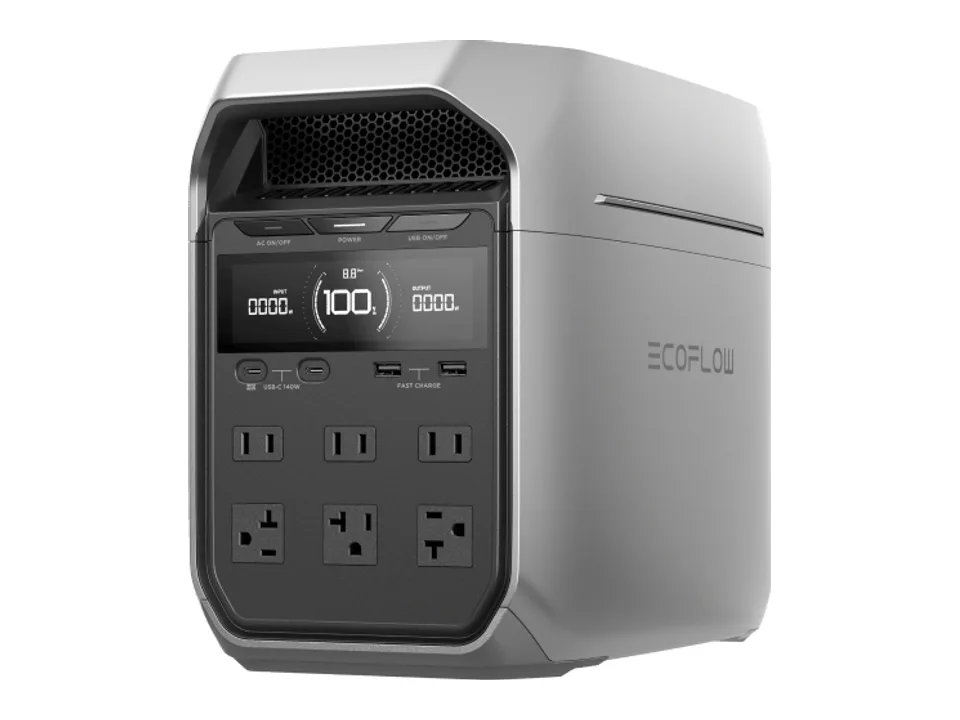
EcoFlow DELTA 3 Plus Portable Power Station
A 1,024 Wh LiFePO4 station with 1,800 W of AC output, a 56-minute wall recharge, 1,000 W of solar input and room to grow to 5 kWh.
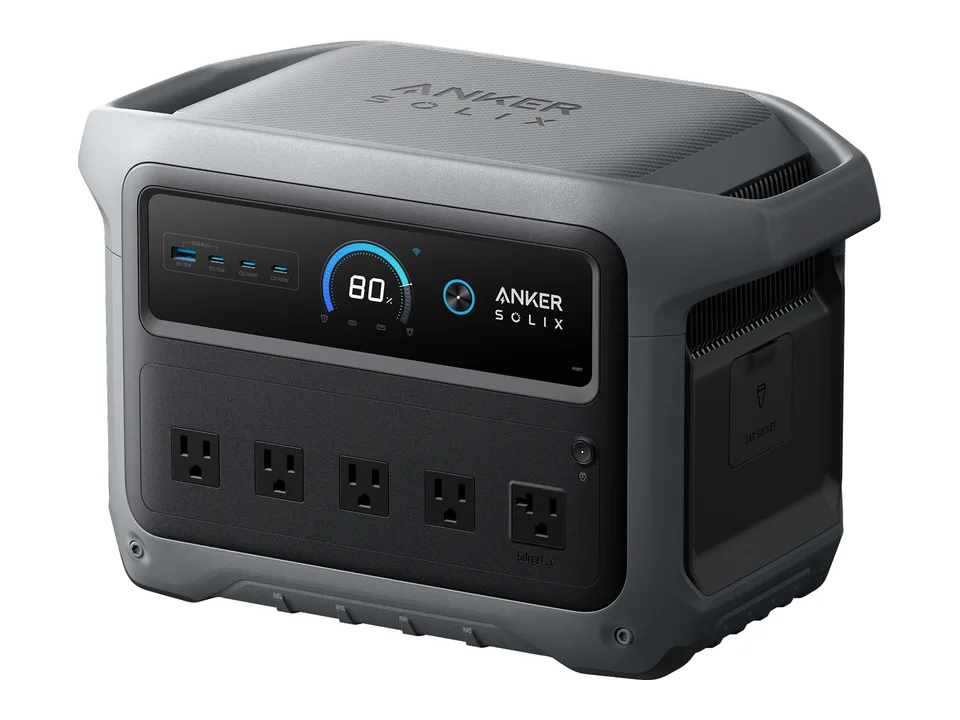
Anker SOLIX C1000 Gen 2 Portable Power Station
A 1,024 Wh station with 2,000 W of AC output and a 49-minute wall recharge in a 24.9 lb body.
Side-by-side
Specs compared
| Specification | EcoFlow DELTA 3 Plus Portable Power StationOur pick | Anker SOLIX C1000 Gen 2 Portable Power Station |
|---|---|---|
| Editorial score | Editorial score:8.8/10 | Editorial score:8.6/10 |
| Best for | Best 1 kWh Overall | Fastest 1 kWh Recharge |
| Capacity | 1,024 Wh | 1,024 Wh |
| Battery chemistry | LiFePO4 (LFP) | LiFePO4 (LFP) |
| Rated cycle life | 4,000 cycles to 80% capacity | 4,000 cycles to 80% capacity |
| AC output | 1,800 W (2,200 W with X-Boost) | 2,000 W |
| Peak output | 3,600 W surge | 3,000 W |
| AC outlets | 6 (US model) | — |
| USB-C output | 2 x 140 W | 1 x 140 W, 1 x 15 W |
| Wall recharge | 0-100% in 56 minutes (1,500 W AC input) | 0-100% in 49 minutes with UltraFast charging (1,600 W input); 1,200 W standard |
| Max solar input | 1,000 W (2 x 500 W MPPT) | 600 W (60 V max) |
| Expandable to | About 5 kWh with DELTA 3, DELTA 2 or DELTA 2 Max extra batteries | Not expandable |
| Backup switchover | Under 10 ms | 10 ms |
| Weight | 27.6 lb (12.5 kg) | 24.9 lb (11.3 kg) |
| Dimensions | 15.7 x 8 x 11.2 in | 15.1 x 8.2 x 9.6 in |
| Warranty | 5 years | Up to 5 years with registration, per Anker |
| Where to buy | Check Latest Price on Amazon (paid link) | Check Latest Price on Amazon (paid link) |
Scroll sideways to see both columns →
At a glance
Key differences
- 1Output: the Anker runs 2,000 W continuous, the EcoFlow 1,800 W (2,200 W with X-Boost).
- 2Wall recharge: 49 minutes for the Anker with UltraFast charging, 56 minutes for the EcoFlow.
- 3Solar input: 1,000 W for the EcoFlow, 600 W for the Anker.
- 4Expansion: the EcoFlow grows to about 5 kWh; the Anker cannot be expanded.
- 5Weight: the Anker is 24.9 lb, the EcoFlow 27.6 lb.
Product by product
Pros and cons
EcoFlow DELTA 3 Plus Portable Power Station
The most complete 1 kWh station we cover: fast to recharge, strong on solar, and expandable when you need more. Pick it unless weight or a lower budget matters more.
Pros
- 4,000-cycle LFP rating, a step up from the DELTA 2's 3,000
- Full recharge from a wall outlet in 56 minutes, by EcoFlow's figures
- 1,000 W of solar input, double the DELTA 2
- Two 140 W USB-C ports charge most laptops at full speed
Cons
- At 27.6 lb it is heavier than the Jackery Explorer 1000 v2 and Anker SOLIX C1000 Gen 2
- Reaching 5 kWh needs extra batteries, sold separately
- X-Boost runs high-wattage heaters and kettles at reduced power, not at their full rating
Anker SOLIX C1000 Gen 2 Portable Power Station
The pick if you charge from the wall and want the most output per pound. Skip it if you plan to grow the system with batteries or a large solar array.
Pros
- 2,000 W of continuous AC output, the highest of the 1 kWh stations we cover
- Fastest wall recharge in this group: 49 minutes with UltraFast charging
- 24.9 lb, almost 3 lb lighter than the EcoFlow DELTA 3 Plus
- 4,000-cycle LFP rating
Cons
- No expansion battery: 1,024 Wh is all you get
- Solar input stops at 600 W
- Only one fast USB-C port; the second is rated at 15 W
- UltraFast charging has to be switched on in the Anker app
Choose the EcoFlow DELTA 3 Plus if
- You plan to add solar panels: it accepts 1,000 W, enough for a larger folding array.
- You might want more capacity later, for a longer outage or an RV trip.
- You want two 140 W USB-C ports for laptops.
Choose the Anker SOLIX C1000 Gen 2 if
- You recharge mostly from the wall and want the fastest turnaround.
- You run appliances that draw close to 2,000 W.
- You carry it often and every pound counts.
What we could not confirm
Anker's regional pages disagree on the C1000 Gen 2's AC outlet count, and Anker ties its warranty term to registration. EcoFlow's outlet count differs by region; the US model has six.
Frequently asked questions
- Which charges faster, the DELTA 3 Plus or the C1000 Gen 2?
- From a wall outlet the Anker is faster: 49 minutes with UltraFast charging, against 56 minutes for the EcoFlow, by each maker's figures.
- Can either of them be expanded?
- Only the EcoFlow. The DELTA 3 Plus expands to about 5 kWh with extra batteries; Anker lists the C1000 Gen 2 as not expandable.
- Which is better for solar?
- The EcoFlow DELTA 3 Plus, with 1,000 W of solar input against the Anker's 600 W.
More comparisons
VS comparison
EcoFlow DELTA 3 Plus Portable Power Station vs EcoFlow DELTA 2 Portable Power Station
Same capacity, same 1,800 W of AC output. The DELTA 3 Plus is the newer design, with longer-rated cells, double the solar input and faster USB-C.
Updated October 15, 2026
VS comparison
Anker SOLIX C1000 Gen 2 Portable Power Station vs Anker SOLIX C1000 Portable Power Station
The Gen 2 is lighter, more powerful and longer-rated. The original C1000 keeps one advantage: it can take an expansion battery.
Updated October 15, 2026
VS comparison
BLUETTI Elite 100 V2 Portable Power Station vs Jackery Explorer 1000 v2 Portable Power Station
Two compact 1 kWh stations within 1.5 lb of each other. The BLUETTI has more output and a stronger cycle rating; the Jackery is lighter and holds a little more energy.
Updated October 15, 2026