Best of · Portable Power Stations
Best Portable Power Stations for Home Backup
Five stations for outages, from a small UPS for your router to 2 kWh systems that expand to 8 or 12 kWh and run a fridge for days.
By Watt Versus Editorial· Updated · 5 picks
This page was drafted with AI assistance from manufacturers' specs and manuals, and is checked by our editor.
The short list
| # | Product | Key feature | Pros / Cons | Buy |
|---|---|---|---|---|
| 1 | BLUETTI AC200L Portable Power StationBest Overall for Home BackupEditorial score:8.7/10 | A 2,048 Wh LiFePO4 station with 2,400 W of AC output, 1,200 W of solar input and a 2,400 W wall-charging input. |
| View on Amazon (paid link) |
| 2 | Jackery Explorer 2000 Plus Portable Power StationMost ExpandableEditorial score:8.6/10 | A 2,042.8 Wh LiFePO4 station with 3,000 W of AC output that expands to 12 kWh with add-on battery packs. |
| View on Amazon (paid link) |
| 3 | Anker SOLIX C2000 Gen 2 Portable Power StationLightest 2 kWh StationEditorial score:8.7/10 | A 2,048 Wh LiFePO4 station of 41.7 lb with 2,400 W of AC output, an RV outlet and expansion to 4 kWh. |
| View on Amazon (paid link) |
| 4 | EcoFlow DELTA 3 Plus Portable Power StationBest 1 kWh BackupEditorial score:8.8/10 | A 1,024 Wh LiFePO4 station with 1,800 W of AC output, a 56-minute wall recharge, 1,000 W of solar input and room to grow to 5 kWh. |
| View on Amazon (paid link) |
| 5 | EcoFlow RIVER 3 Plus Portable Power StationBest for Internet BackupEditorial score:7.9/10 | A 286 Wh LiFePO4 station of 10.4 lb with a one-hour recharge, a 10 ms UPS switchover and add-on batteries up to 858 Wh. |
| View on Amazon (paid link) |
What matters for home backup
- Capacity and expansion. A full-size fridge needs roughly 1 to 2 kWh a day. A station that takes extra batteries lets you start with 2 kWh and add more later.
- Output. Continuous output decides what you can run at once; surge output decides whether a fridge or pump compressor will start.
- UPS switchover. A switchover of 20 ms or less keeps most computers and routers running when the grid drops.
- Recharge. Fast wall charging matters when power comes back briefly; solar input matters in a long outage.
Our fridge runtime guide shows how to estimate hours for your own appliances.
Our picks in detail
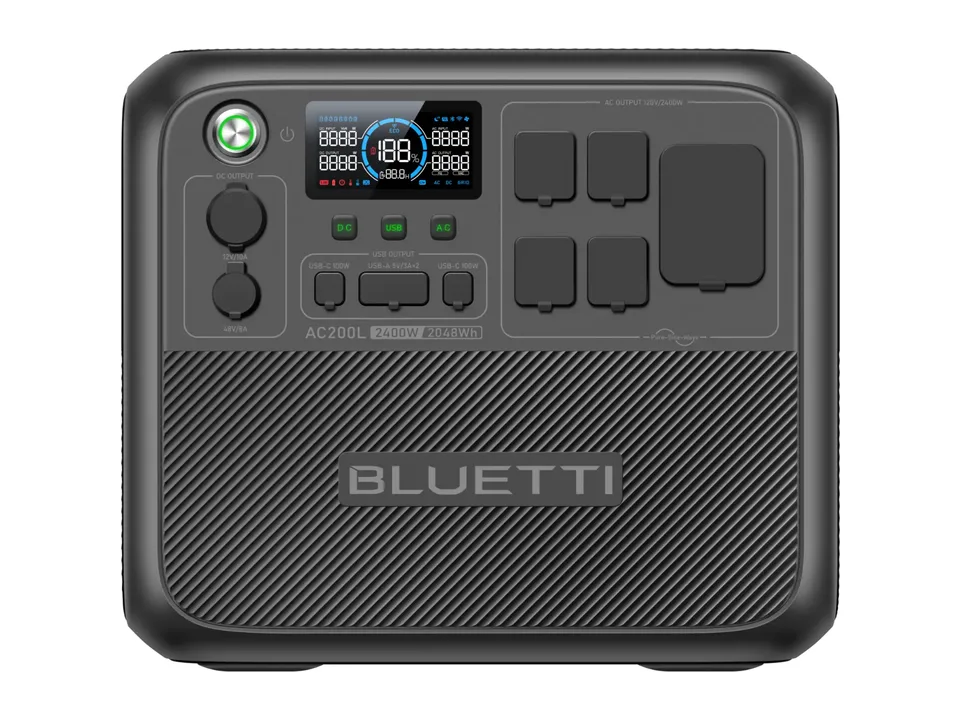
BLUETTI AC200L Portable Power Station
BLUETTI · AC200L
2,048 Wh that expands to about 8 kWh, 2,400 W of wall charging, 1,200 W of solar and a 20 ms switchover: built to sit in a house and keep it running.
- Capacity
- 2,048 Wh
- Battery chemistry
- LiFePO4 (LFP)
- AC output
- 2,400 W
- Peak output
- 3,600 W in Power Lifting mode
- Wall recharge
- 2,400 W AC input
- Max solar input
- 1,200 W
Pros
- 1,200 W of solar input, more than the EcoFlow DELTA 2 Max or Anker SOLIX F2000 accept
- Accepts 2,400 W from a wall outlet for fast recharging
- Expands to as much as 8,192 Wh
- Published switchover time of 20 ms or less, and a 5-year warranty
Cons
- 62.4 lb, so plan to move it rarely
- BLUETTI's own pages give two different maximum expansion figures (7,577.6 Wh and 8,192 Wh), depending on the battery used
- The 3,600 W figure is Power Lifting mode for heating appliances, not a surge rating for motors
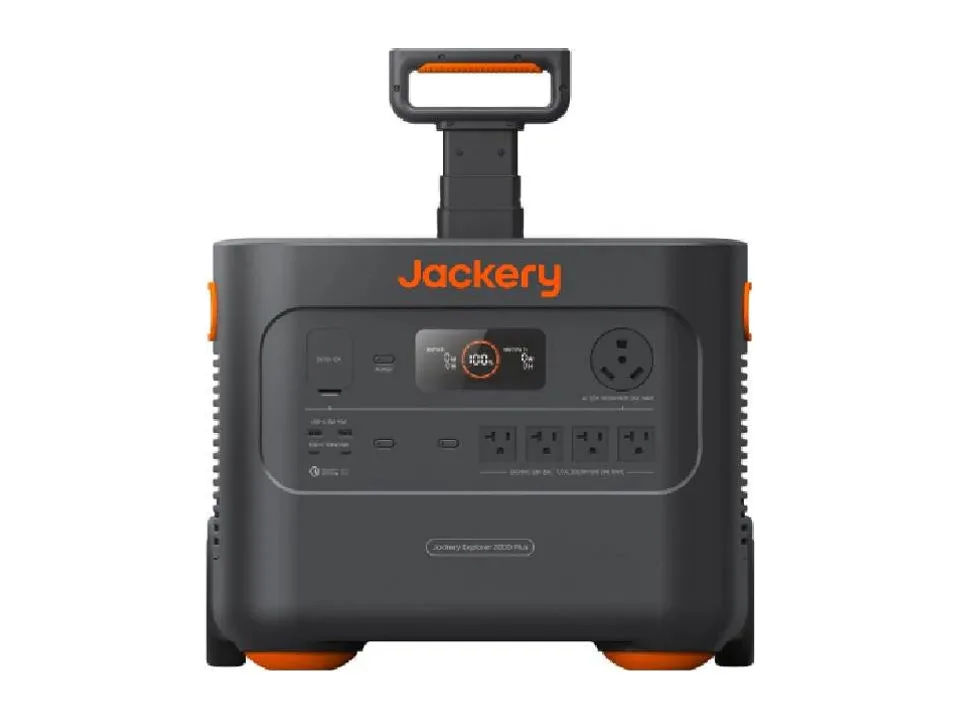
Jackery Explorer 2000 Plus Portable Power Station
Jackery · Explorer 2000 Plus
3,000 W of output with a 6,000 W surge and expansion to 12 kWh, for larger loads such as a well pump or window air conditioner.
- Capacity
- 2,042.8 Wh
- Battery chemistry
- LiFePO4 (LFP)
- AC output
- 3,000 W
- Peak output
- 6,000 W surge
- Wall recharge
- Under 2 hours, per Jackery
- Max solar input
- Up to six 200 W panels; about 2 hours to full, per Jackery
Pros
- 3,000 W of continuous output, the highest of the 2 kWh models we cover
- Expands to 12 kWh with up to five add-on packs
- Jackery says six 200 W panels can refill it in about 2 hours
Cons
- 61.5 lb before you add any battery packs
- The 2-year warranty extension is applied automatically only to purchases from Jackery's website; elsewhere, check the terms
- Jackery's pages give different wall-charging times for this model
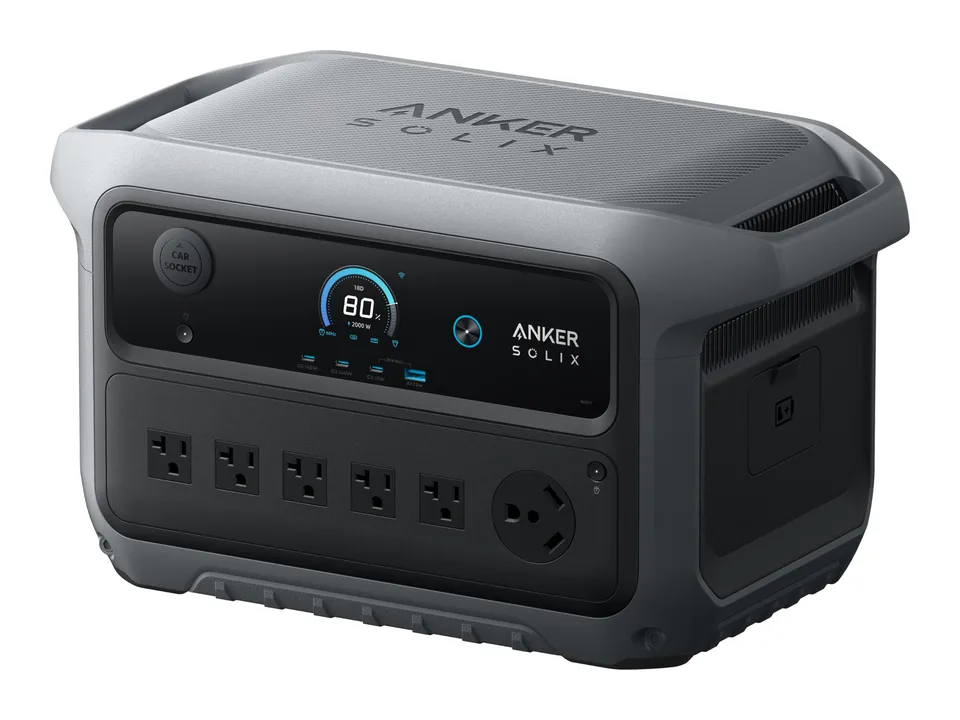
Anker SOLIX C2000 Gen 2 Portable Power Station
Anker · SOLIX C2000 Gen 2 (A1783)
41.7 lb with a 10 ms switchover and a TT-30R outlet: 2 kWh of backup that doubles as an RV power source.
- Capacity
- 2,048 Wh
- Battery chemistry
- LiFePO4 (LFP)
- Rated cycle life
- 4,000 cycles to 80% capacity (US page)
- AC output
- 2,400 W
- Peak output
- 4,000 W
- AC outlets
- Includes one NEMA 5-20R and one TT-30R RV outlet
Pros
- 41.7 lb: the lightest 2 kWh station we cover, by about 8 lb
- TT-30R outlet plugs straight into an RV's 30 A inlet
- Two 140 W USB-C ports
- Expands to about 4 kWh with one add-on battery
Cons
- 800 W of solar input is the lowest in the 2 kWh group
- Expansion stops at one extra battery, where Jackery's Explorer 2000 Plus reaches 12 kWh
- Anker's regional pages disagree on whether 4,000 cycles is to 80% or 70% capacity
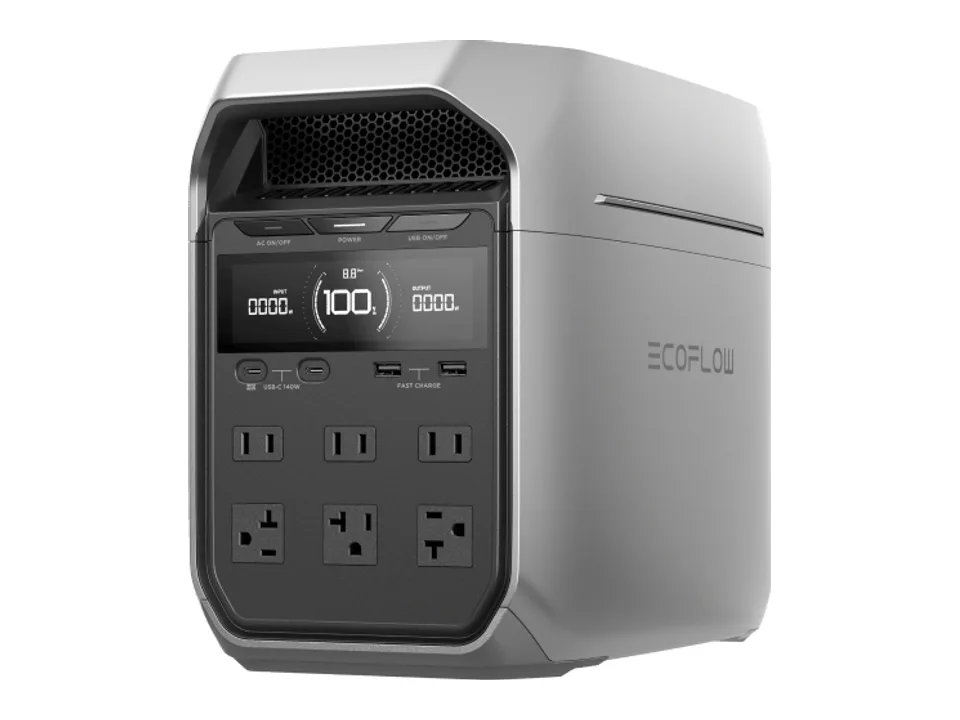
EcoFlow DELTA 3 Plus Portable Power Station
EcoFlow · DELTA 3 Plus
A sub-10 ms switchover and a 56-minute recharge in a 1 kWh station that can grow to 5 kWh.
- Capacity
- 1,024 Wh
- Battery chemistry
- LiFePO4 (LFP)
- Rated cycle life
- 4,000 cycles to 80% capacity
- AC output
- 1,800 W (2,200 W with X-Boost)
- Peak output
- 3,600 W surge
- AC outlets
- 6 (US model)
Pros
- 4,000-cycle LFP rating, a step up from the DELTA 2's 3,000
- Full recharge from a wall outlet in 56 minutes, by EcoFlow's figures
- 1,000 W of solar input, double the DELTA 2
- Two 140 W USB-C ports charge most laptops at full speed
Cons
- At 27.6 lb it is heavier than the Jackery Explorer 1000 v2 and Anker SOLIX C1000 Gen 2
- Reaching 5 kWh needs extra batteries, sold separately
- X-Boost runs high-wattage heaters and kettles at reduced power, not at their full rating
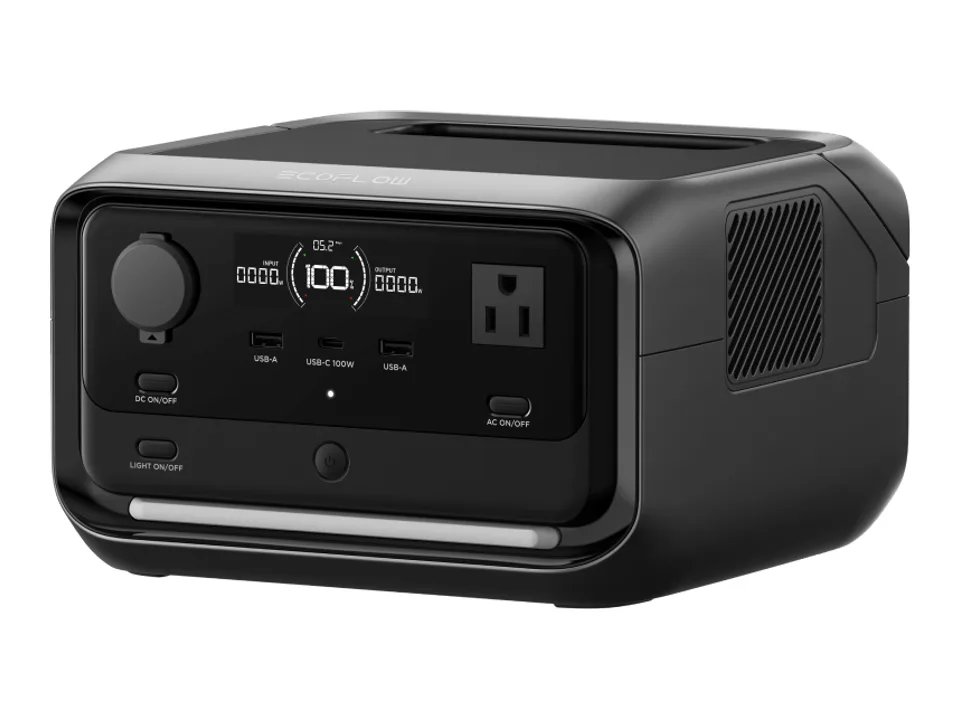
EcoFlow RIVER 3 Plus Portable Power Station
EcoFlow · RIVER 3 Plus (EF-RV-H02-1)
A 286 Wh UPS with a sub-10 ms switchover: keeps a modem, router and laptop online through most outages.
- Capacity
- 286 Wh
- Battery chemistry
- LiFePO4 (LFP)
- Rated cycle life
- 3,000 cycles to 80% capacity
- AC output
- 600 W
- Peak output
- 1,200 W surge (X-Boost 1,200 W)
- USB-C output
- 1 x 100 W
Pros
- Under 10 ms UPS switchover, quick enough for a router or a desktop PC
- Full recharge from the wall in an hour
- Can grow from 286 Wh to 858 Wh with an add-on battery
- 10.4 lb and small enough for a car footwell
Cons
- 600 W of AC output rules out kettles, hair dryers and most power tools
- Only one USB-C port
- 286 Wh runs a typical fridge for a few hours, not a whole day
Frequently asked questions
- Can a portable power station run a refrigerator during an outage?
- Yes. A typical full-size fridge uses roughly 1 to 2 kWh a day, so a 2 kWh station covers about a day, and expansion batteries extend that.
- What is a good UPS switchover time?
- 20 ms or less keeps most computers and network gear running. Four of the five picks publish a figure of 20 ms or less; Jackery gives none for the Explorer 2000 Plus on the pages we read.
- Can I charge a power station from solar during an outage?
- Yes. All five picks accept solar input; the BLUETTI AC200L takes the most, at 1,200 W.