Head-to-head comparison · Portable Power Stations
EcoFlow DELTA 3 vs DELTA 2: What Changed
Both store 1,024 Wh of LiFePO4 and put out 1,800 W with 500 W of solar input and a 5-year warranty. The DELTA 3 recharges faster, has a higher surge and cycle rating, and expands further.
By Watt Versus Editorial· Updated
This page was drafted with AI assistance from manufacturers' specs and manuals, and is checked by our editor.
Why the EcoFlow DELTA 3 Portable Power Station (1,024 Wh) wins
Same capacity and output, but the DELTA 3 refills from the wall in 56 minutes against 80, handles a 3,600 W surge against 2,700 W, is rated for 4,000 cycles against 3,000, and expands to about 5 kWh against about 3 kWh. Buy the DELTA 2 only if you already own DELTA 2 extra batteries or find it for much less.
Prices change often. Check the current price and availability on Amazon.
Check Latest Price on Amazon (paid link)EcoFlow DELTA 3 Portable Power Station (1,024 Wh)
A 1,024 Wh LiFePO4 station with 1,800 W AC output, a 56-minute wall recharge, 500 W solar input and about 5 kWh of expansion.
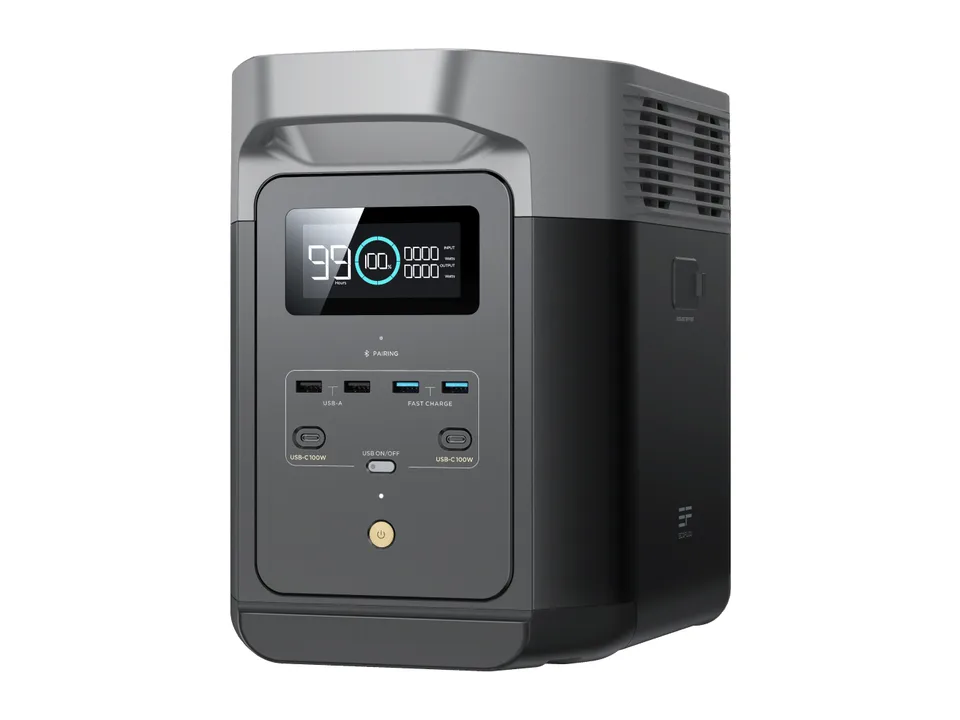
EcoFlow DELTA 2 Portable Power Station
A 1,024 Wh LiFePO4 power station with 1,800 W of AC output that can grow to about 3 kWh with an extra battery.
Side-by-side
Specs compared
| Specification | EcoFlow DELTA 3 Portable Power Station (1,024 Wh)Our pick | EcoFlow DELTA 2 Portable Power Station |
|---|---|---|
| Editorial score | Editorial score:8.3/10 | Editorial score:8.0/10 |
| Best for | Expandable 1 kWh DELTA with 500 W Solar | — |
| Capacity | 1,024 Wh | 1,024 Wh |
| Battery chemistry | LiFePO4 (LFP) | LiFePO4 (LFP) |
| Rated cycle life | 4,000 cycles to 80% capacity | 3,000+ cycles to 80% capacity |
| AC output | 1,800 W | 1,800 W |
| Peak output | 3,600 W surge | 2,700 W surge |
| Wall recharge | 0-100% in 56 minutes (1,500 W AC input) | 0-80% in 50 minutes, full in 80 minutes (EcoFlow lab figures) |
| Max solar input | 500 W (11-60 V) | 500 W |
| Expandable to | About 5 kWh with extra batteries, per EcoFlow | About 3 kWh with a DELTA 2 or DELTA 2 Max extra battery |
| Weight | 27.6 lb (12.5 kg) | 27 lb (12 kg) |
| Dimensions | 15.7 x 7.9 x 11.2 in (398 x 200 x 284 mm) | 15.7 x 8.3 x 11 in |
| Warranty | 5 years | 5 years |
| Where to buy | Check Latest Price on Amazon (paid link) | Check Latest Price on Amazon (paid link) |
Scroll sideways to see both columns →
How long it runs: estimated hours
Estimates use 80% of the rated capacity as usable energy, after inverter losses and battery reserve (see our sizing guide). Draws are typical figures; check the label on your own device.
| Device (typical draw) | EcoFlow DELTA 3 Portable Power Station (1,024 Wh) | EcoFlow DELTA 2 Portable Power Station |
|---|---|---|
| Wi-Fi router (10 W) | about 82 h | about 82 h |
| CPAP without humidifier (40 W) | about 20 h | about 20 h |
| Laptop (60 W) | about 14 h | about 14 h |
| Full-size fridge, average (68 W) | about 12 h | about 12 h |
| Box fan (75 W) | about 11 h | about 11 h |
| 55-inch LED TV (100 W) | about 8.2 h | about 8.2 h |
At a glance
Key differences
- 1Wall recharge: full in 56 minutes vs 80 minutes
- 2Peak output: 3,600 W vs 2,700 W surge
- 3Rated cycle life: 4,000 vs 3,000+ cycles to 80%
- 4Expandable to: about 5 kWh vs about 3 kWh
- 5Weight: 27.6 lb vs 27 lb
Product by product
Pros and cons
EcoFlow DELTA 3 Portable Power Station (1,024 Wh)
A solid 1 kWh EcoFlow for home backup and camping if 500 W of solar is enough. If you plan a bigger solar array, the DELTA 3 Plus takes twice the input.
Pros
- 56-minute full recharge from a wall outlet at 1,500 W, by EcoFlow
- 4,000 cycles to 80% capacity, the same rating as the DELTA 3 Plus and Anker C1000 Gen 2
- Expands to about 5 kWh with extra batteries
- 5-year warranty
Cons
- Half the solar input of the DELTA 3 Plus: 500 W against 1,000 W
- 27.6 lb, heavier than the 23.8 lb Jackery Explorer 1000 v2
- We could not confirm the US outlet count or USB-C wattage on EcoFlow's pages
EcoFlow DELTA 2 Portable Power Station
The DELTA 2 is still a capable 1 kWh station, and the option to add a battery later is its best feature. Buy it for that; if you want the longest-lasting cells in this size, look at newer models first.
Pros
- Charges from a wall outlet to 80% in 50 minutes, by EcoFlow's figures
- Capacity can roughly triple with one extra battery
- LiFePO4 cells rated for 3,000+ cycles, backed by a 5-year warranty
- X-Boost mode lets it run some appliances rated up to 2,200 W at reduced power
Cons
- An older design: EcoFlow now sells the DELTA 3, which it rates for 4,000 cycles and a faster recharge
- Solar input tops out at 500 W, below the 600 W the Anker SOLIX C1000 accepts
- EcoFlow describes the backup switchover only as "almost instant" and gives no figure in milliseconds
Choose the DELTA 3 if
- You want the faster recharge and higher surge for motors and compressors.
- You may grow the system past 3 kWh.
Choose the DELTA 2 if
- You already have DELTA 2 or DELTA 2 Max extra batteries.
- The lower cycle rating and slower recharge do not matter to you.
Both take 500 W of solar. If you want more, see DELTA 3 vs DELTA 3 Plus; the Plus takes 1,000 W. For a fridge, both run an average 68 W fridge for about 12 hours by our refrigerator guide.
Frequently asked questions
- Is the EcoFlow DELTA 3 better than the DELTA 2?
- By EcoFlow's specs it recharges faster (56 vs 80 minutes), has a higher surge (3,600 vs 2,700 W), more rated cycles (4,000 vs 3,000) and more expansion (about 5 vs 3 kWh). Capacity and output are the same.
- Do the DELTA 3 and DELTA 2 have the same capacity?
- Yes, both are 1,024 Wh.
- Which is heavier?
- They are close: 27.6 lb for the DELTA 3 and 27 lb for the DELTA 2.
Sources
The specifications and claims on this page come from these manufacturer documents. Figures are the manufacturers' own unless the text says otherwise.
More comparisons
VS comparison
Jackery Explorer 1000 v2 Portable Power Station vs EcoFlow DELTA 3 Portable Power Station (1,024 Wh)
Two of the most searched 1 kWh stations. The Jackery is lighter with slightly more capacity; the EcoFlow has more AC output, a higher surge and can add batteries.
Updated November 12, 2026
VS comparison
BLUETTI AC180 Portable Power Station vs EcoFlow DELTA 3 Portable Power Station (1,024 Wh)
Two 1,800 W LiFePO4 stations with 500 W of solar input and 5-year warranties. The BLUETTI stores a little more; the EcoFlow is 7.7 lb lighter, recharges fully in under an hour and is rated for more cycles.
Updated November 12, 2026
VS comparison
Anker SOLIX C1000 Gen 2 Portable Power Station vs EcoFlow DELTA 3 Portable Power Station (1,024 Wh)
Two 1,024 Wh LiFePO4 stations rated for 4,000 cycles to 80%. The Anker puts out more power, recharges faster and is lighter; the EcoFlow can add batteries.
Updated November 12, 2026