BLUETTI AC70 Portable Power Station Review
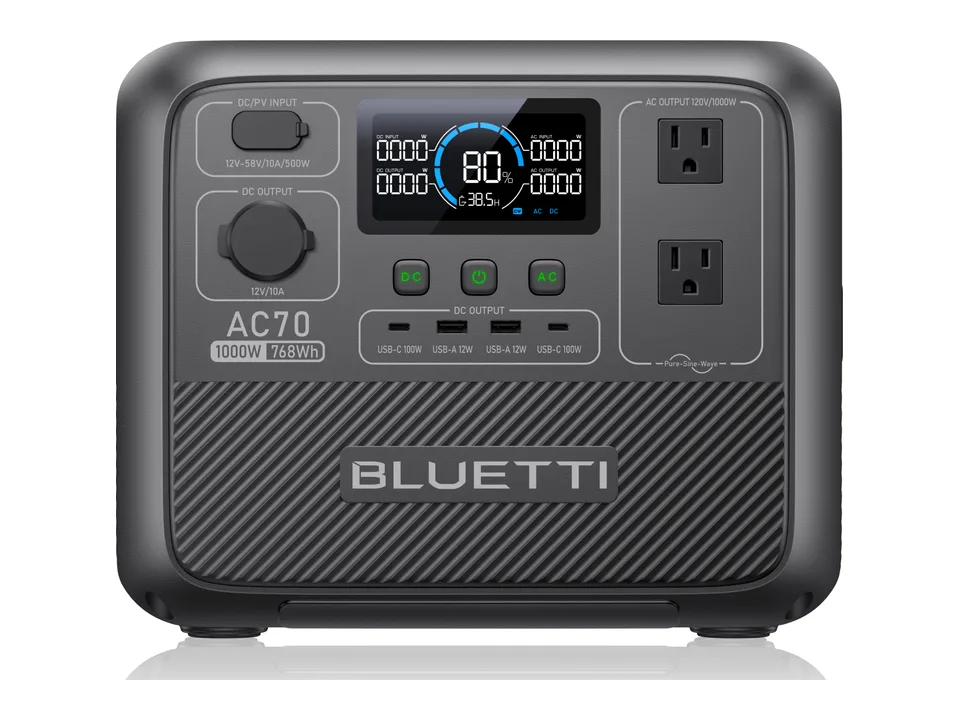
A 768 Wh LiFePO4 station with 1,000 W of AC output, 500 W of solar input, two 100 W USB-C ports and a 20 ms UPS switchover.
By Watt Versus Editorial· Updated
This page was drafted with AI assistance from manufacturers' specs and manuals, and is checked by our editor.
Our verdict
The mid-size pick for solar charging and USB-C devices. If weight matters more than solar input, the RIVER 2 Pro is lighter.
Pros and cons
Pros
- 500 W of solar input, more than double the RIVER 2 Pro's 220 W
- 1,000 W of AC output with a 2,000 W power-lifting mode for kettles and hair dryers
- Two 100 W USB-C ports
- LiFePO4 cells rated for 3,000+ cycles, backed by a 5-year warranty
Cons
- Only two AC outlets
- 22.5 lb, heavier than the 18.2 lb EcoFlow RIVER 2 Pro
- Power lifting runs resistive heaters at reduced power; it is not a true 2,000 W output
- BLUETTI's pages give different surge figures, so we leave surge out
Specifications
| Capacity | 768 Wh |
|---|---|
| Battery chemistry | LiFePO4 (LFP) |
| Rated cycle life | 3,000+ cycles to 80% capacity |
| AC output | 1,000 W (2,000 W power lifting for resistive loads) |
| AC outlets | 2 |
| USB-C output | 2 x 100 W |
| Wall recharge | 0-80% in 45 minutes in turbo mode; 950 W max AC input |
| Max solar input | 500 W |
| Expandable to | 1,574 Wh with a B80 battery (AC70 + B80 kit) |
| Backup switchover | 20 ms |
| Weight | 22.5 lb |
| Dimensions | 12.4 x 8.2 x 10.1 in |
| Warranty | 5 years |
Who it suits
Campers and van owners who recharge from panels: BLUETTI rates the AC70 for 500 W of solar input and a turbo wall charge to 80% in 45 minutes. Two 100 W USB-C ports cover laptops and cameras, and the 1,000 W inverter runs most small appliances.
Compare it with the EcoFlow RIVER 2 Pro in AC70 vs RIVER 2 Pro.
Who should skip it
Anyone who needs to run several AC devices at once (there are two outlets) or a microwave above 1,000 W. Power lifting is meant for resistive loads such as kettles, which run at reduced power. A 1 kWh station such as the EcoFlow DELTA 3 Plus has more outlets and output.
What we could not confirm
BLUETTI's pages list surge as both 2,000 W and 1,500 W, and AC input as 950 W and 850 W turbo, so the table shows only the figures its US product page states. The 1,574 Wh expansion figure comes from BLUETTI's AC70 + B80 kit listing.
Frequently asked questions
- How long does the BLUETTI AC70 take to charge?
- BLUETTI rates turbo AC charging at 0-80% in 45 minutes. With solar, it accepts up to 500 W.
- Can the AC70 run a 1,500 W kettle?
- In power-lifting mode it can run resistive heating devices up to 2,000 W at reduced power, per BLUETTI. Its regular rated output is 1,000 W.
- Does the AC70 work as a UPS?
- Yes. BLUETTI lists a 20 ms UPS switchover, which suits routers and lights; check your computer's tolerance before relying on it.
Sources
The specifications and claims on this page come from these manufacturer documents. Figures are the manufacturers' own unless the text says otherwise.
Ready to buy the BLUETTI AC70 Portable Power Station?
Prices change often. See the current price and availability on Amazon.
Compare and read more
VS comparison
BLUETTI AC70 Portable Power Station vs EcoFlow RIVER 2 Pro Portable Power Station
Both hold 768 Wh in LiFePO4 cells with a 5-year warranty. The AC70 has more output, more solar input and a second USB-C port; the RIVER 2 Pro is 4.3 lb lighter.
Updated October 22, 2026
Best of
Best Portable Power Stations for Camping (2026)
Five stations for tents, vans and overlanding, from a 288 Wh pack under 9 lb to a 1 kWh station that refills from solar in a day.
Updated October 22, 2026