Anker SOLIX C1000 Gen 2 Portable Power Station Review
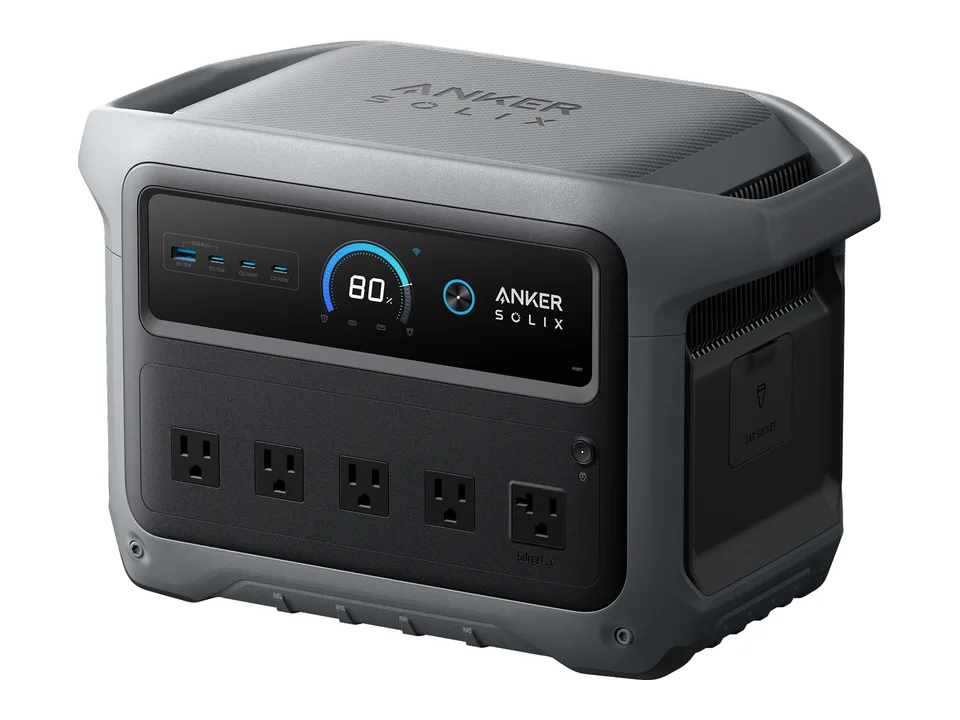
A 1,024 Wh station with 2,000 W of AC output and a 49-minute wall recharge in a 24.9 lb body.
By Watt Versus Editorial· Updated
This page was drafted with AI assistance from manufacturers' specs and manuals, and is checked by our editor.
Our verdict
The pick if you charge from the wall and want the most output per pound. Skip it if you plan to grow the system with batteries or a large solar array.
Pros and cons
Pros
- 2,000 W of continuous AC output, the highest of the 1 kWh stations we cover
- Fastest wall recharge in this group: 49 minutes with UltraFast charging
- 24.9 lb, almost 3 lb lighter than the EcoFlow DELTA 3 Plus
- 4,000-cycle LFP rating
Cons
- No expansion battery: 1,024 Wh is all you get
- Solar input stops at 600 W
- Only one fast USB-C port; the second is rated at 15 W
- UltraFast charging has to be switched on in the Anker app
Specifications
| Capacity | 1,024 Wh |
|---|---|
| Battery chemistry | LiFePO4 (LFP) |
| Rated cycle life | 4,000 cycles to 80% capacity |
| AC output | 2,000 W |
| Peak output | 3,000 W |
| USB-C output | 1 x 140 W, 1 x 15 W |
| Wall recharge | 0-100% in 49 minutes with UltraFast charging (1,600 W input); 1,200 W standard |
| Max solar input | 600 W (60 V max) |
| Expandable to | Not expandable |
| Backup switchover | 10 ms |
| Weight | 24.9 lb (11.3 kg) |
| Dimensions | 15.1 x 8.2 x 9.6 in |
| Warranty | Up to 5 years with registration, per Anker |
The full review
Who it suits
Home-backup buyers and tailgaters who recharge mostly from a wall outlet and want to run high-draw appliances, such as a microwave or a space heater on low, from a station that one person can carry.
Who should skip it
Anyone planning an off-grid solar setup: the 600 W solar limit is below the EcoFlow DELTA 3 Plus and BLUETTI Elite 100 V2, and there is no way to add capacity later.
What we could not confirm
Anker's US product page and its Australian page show different AC outlet counts, so we have left the count out. Anker's US pages say "up to 5 years" of warranty and tie the full term to registering the product; we could not find the term stated for an unregistered unit. Do not confuse this model with the C1000X Gen 2 sold by some big-box stores, which has a different outlet layout.
Frequently asked questions
- How fast does the Anker SOLIX C1000 Gen 2 charge?
- Anker rates it at 0-100% in 49 minutes from a wall outlet with UltraFast charging (1,600 W), which you switch on in the Anker app. Standard AC charging is 1,200 W.
- Can you add a battery to the C1000 Gen 2?
- No. Anker's spec table lists it as not expandable. Look at the SOLIX C2000 Gen 2 if you want to add capacity.
- Is the C1000 Gen 2 the same as the C1000X Gen 2?
- No. The C1000X Gen 2 is a variant sold through some retailers with a different outlet layout. Check the model name before buying.
Ready to buy the Anker SOLIX C1000 Gen 2 Portable Power Station?
Prices change often. See the current price and availability on Amazon.
Compare and read more
VS comparison
Anker SOLIX C1000 Gen 2 Portable Power Station vs Anker SOLIX C1000 Portable Power Station
The Gen 2 is lighter, more powerful and longer-rated. The original C1000 keeps one advantage: it can take an expansion battery.
Updated October 15, 2026
VS comparison
EcoFlow DELTA 3 Plus Portable Power Station vs Anker SOLIX C1000 Gen 2 Portable Power Station
Both store about 1 kWh in LFP cells rated for 4,000 cycles. The Anker puts out more power and charges faster from the wall; the EcoFlow takes twice the solar and can grow to 5 kWh.
Updated October 15, 2026
Best of
Best 1,000 Wh Portable Power Stations
Seven 1 kWh stations ranked on the manufacturers' numbers: output, cycle life, wall and solar recharge, expansion and weight.
Updated October 15, 2026
How-to guide
LiFePO4 vs NMC: Which Power Station Battery Lasts Longer?
Most new power stations use LiFePO4 cells. Here is what that means for lifespan and weight, and how to compare cycle ratings properly.
Updated October 15, 2026