Head-to-head comparison · Portable Power Stations
EcoFlow DELTA Pro Ultra vs DELTA Pro 3
EcoFlow's two home backup systems. The Ultra is a modular inverter-and-battery stack that scales to 90 kWh; the DELTA Pro 3 is one wheeled box with 120/240 V output.
By Watt Versus Editorial· Updated
This page was drafted with AI assistance from manufacturers' specs and manuals, and is checked by our editor.
Why the EcoFlow DELTA Pro 3 Portable Power Station wins
For most homes the DELTA Pro 3 is the easier buy: 4,096 Wh and 4,000 W at 120/240 V in one 113.5 lb box, 4,000 cycles to 80% and a 10 ms switchover. Choose the Ultra if you need 7,200 W, more than 2,600 W of solar or more than 12 kWh of storage.
Prices change often. Check the current price and availability on Amazon.
Check Latest Price on Amazon (paid link)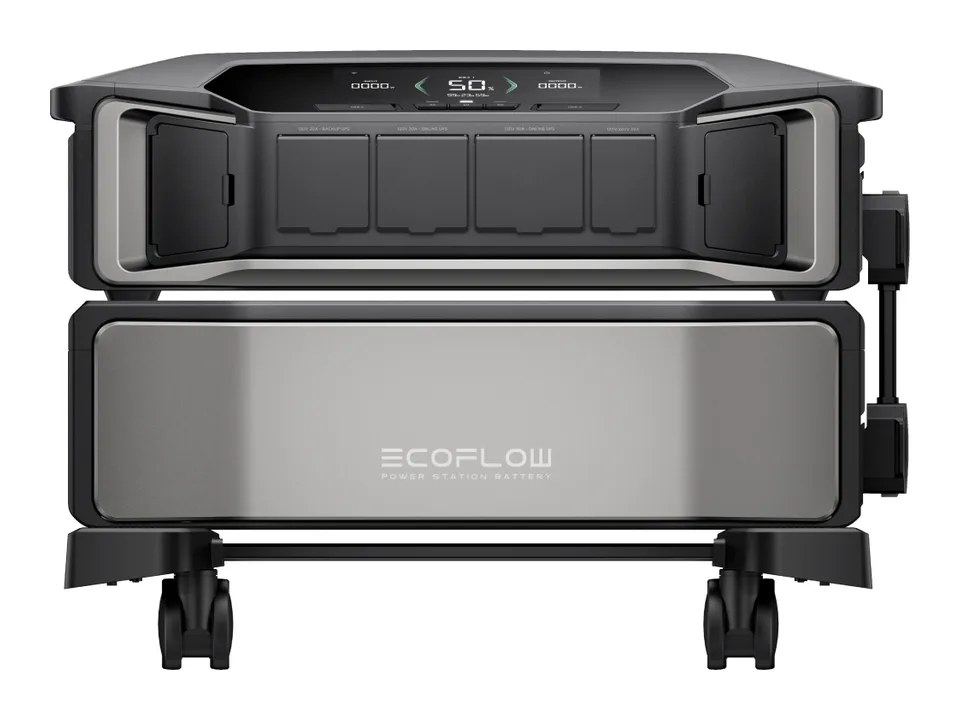
EcoFlow DELTA Pro Ultra Home Backup System (6,144 Wh)
A two-piece home backup system: a 7,200 W 120/240 V inverter on a 6,144 Wh LFP battery, with 5,600 W of solar input and expansion to 90 kWh.
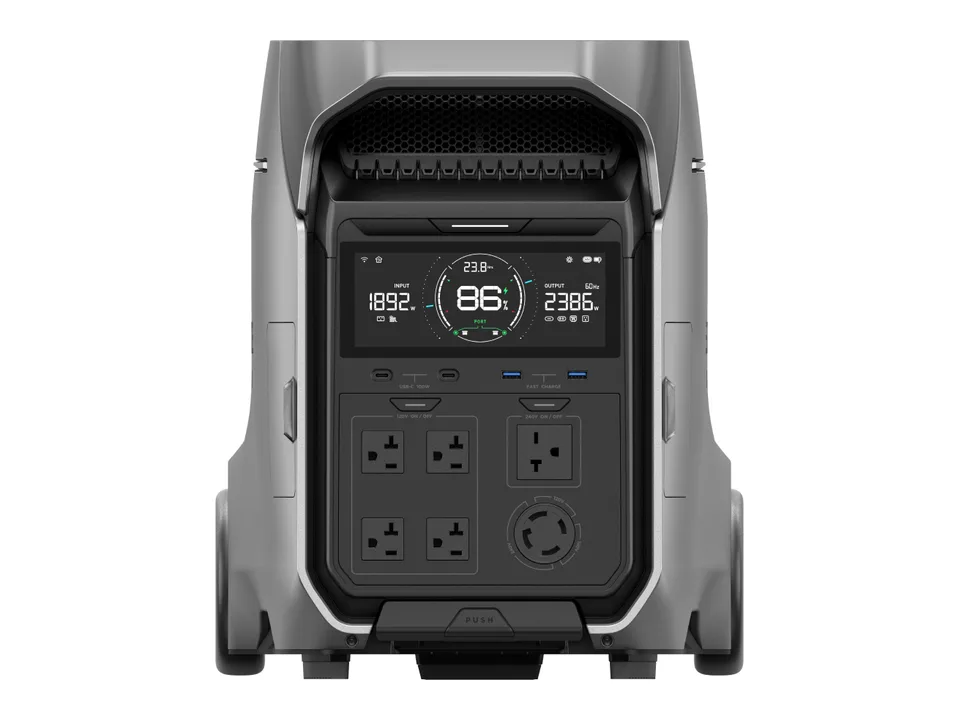
EcoFlow DELTA Pro 3 Portable Power Station
A 4,096 Wh LFP station with 120 V and 240 V output, 4,000 W continuous, 2,600 W of solar input and expansion to 12 kWh with two extra batteries.
Side-by-side
Specs compared
| Specification | EcoFlow DELTA Pro Ultra Home Backup System (6,144 Wh) | EcoFlow DELTA Pro 3 Portable Power StationOur pick |
|---|---|---|
| Editorial score | Editorial score:8.9/10 | Editorial score:9.0/10 |
| Best for | Most Solar Input and Expansion | Best Whole-Home Backup |
| Capacity | 6,144 Wh per battery (102.4 V, 60 Ah) | 4,096 Wh |
| Battery chemistry | LiFePO4 (LFP) | LiFePO4 (LFP) |
| Rated cycle life | 3,500 cycles to 80% capacity | 4,000 cycles to 80% capacity |
| AC output | 7,200 W at 120/240 V | 4,000 W at 120/240 V (X-Boost up to 6,000 W) |
| Peak output | 10,800 W surge | 8,000 W surge |
| AC outlets | 2 x 120 V 20 A and 1 x 120/240 V 30 A (backup UPS side); 2 x 120 V 20 A and 1 x 120 V 30 A (online UPS side) | 4 x NEMA 5-20R and 1 x TT-30R at 120 V; 1 x NEMA 6-20R at 240 V; 1 x L14-30R at 120/240 V |
| USB-C output | 2 x 100 W | 2 x 100 W |
| Wall recharge | 120 V, 15 A or 240 V, 12.5 A AC input; EcoFlow quotes about 2 hours for two batteries at its 8,800 W combined charging maximum | 0-80% in 50 minutes, per EcoFlow; AC input 100-240 V, 15 A |
| Max solar input | 5,600 W (4,000 W high-voltage port, 80-450 V, plus 1,600 W port, 30-150 V) | 2,600 W (1,600 W high-voltage port + 1,000 W low-voltage port) |
| Expandable to | 30 kWh per inverter (five batteries); 90 kWh with three inverters and Smart Home Panel 2 | 12 kWh with two DELTA Pro 3 Smart Extra Batteries |
| Backup switchover | 0 ms in online UPS mode; under 20 ms in backup UPS mode | 10 ms |
| Weight | 70 lb inverter + 111.8 lb battery (181.8 lb in total) | 113.5 lb (51.5 kg) |
| Dimensions | Inverter 27.2 x 18.9 x 8.4 in; battery 26 x 18 x 8 in | 16.2 x 13.4 x 27.3 in |
| Warranty | 5 years | 5 years (3 years standard plus 2 years with EcoFlow app registration) |
| Where to buy | Check Latest Price on Amazon (paid link) | Check Latest Price on Amazon (paid link) |
Scroll sideways to see both columns →
How long it runs: estimated hours
Estimates use 80% of the rated capacity as usable energy, after inverter losses and battery reserve (see our sizing guide). Draws are typical figures; check the label on your own device.
| Device (typical draw) | EcoFlow DELTA Pro Ultra Home Backup System (6,144 Wh) | EcoFlow DELTA Pro 3 Portable Power Station |
|---|---|---|
| Wi-Fi router (10 W) | about 492 h | about 328 h |
| CPAP without humidifier (40 W) | about 123 h | about 82 h |
| Laptop (60 W) | about 82 h | about 55 h |
| Full-size fridge, average (68 W) | about 72 h | about 48 h |
| Box fan (75 W) | about 66 h | about 44 h |
| 55-inch LED TV (100 W) | about 49 h | about 33 h |
At a glance
Key differences
- 1Capacity: 6,144 Wh vs 4,096 Wh
- 2AC output: 7,200 W vs 4,000 W
- 3Max solar input: 5,600 W vs 2,600 W
- 4Expandable to: 90 kWh system vs 12 kWh
- 5Weight: 181.8 lb in two pieces vs 113.5 lb
Product by product
Pros and cons
EcoFlow DELTA Pro Ultra Home Backup System (6,144 Wh)
The biggest system we cover, built for whole-home backup and large rooftop-size solar arrays. It is a semi-permanent install, not something you carry; for one-box backup the DELTA Pro 3 is easier to live with.
Pros
- 5,600 W of solar input, the most of any station we cover
- Expands to 30 kWh on one inverter and 90 kWh as a three-inverter system
- Online UPS mode with 0 ms switchover, by EcoFlow
- 7,200 W at 120/240 V runs well pumps, dryers and central AC loads
Cons
- Two pieces totaling 181.8 lb; the battery alone is 111.8 lb
- Rated 3,500 cycles to 80%, fewer than the DELTA Pro 3's 4,000
- EcoFlow's US store showed it sold out when we checked
EcoFlow DELTA Pro 3 Portable Power Station
The pick for backing up a whole house: 4 kWh in one unit, real 240 V output and room to grow to 12 kWh. If you need more solar input or 6,000 W from a single unit, look at the Anker SOLIX F3800 Plus.
Pros
- 4,096 Wh and 4,000 W continuous at 120 V or 240 V from one unit, with a 240 V L14-30R outlet for a transfer switch
- Up to 2,600 W of solar input across two ports
- 4,000 cycles to 80% capacity and a 10 ms backup switchover, by EcoFlow's figures
- Grows to 12 kWh with two Smart Extra Batteries, more with EcoFlow's home panel
Cons
- 113.5 lb: it rolls on wheels, but it is heavy to lift into a vehicle
- EcoFlow's 0-80% in 50 minutes figure does not say which input it assumes; a standard 120 V, 15 A outlet can supply at most 1,800 W
- Wiring it into the house needs EcoFlow's Smart Home Panel 2 or a transfer switch, installed by an electrician
- The full 5-year warranty needs registration in the EcoFlow app; the standard warranty is 3 years
Choose the DELTA Pro 3 if
- You want one box you can roll to the panel.
- 4,000 W at 120/240 V covers your essential circuits.
Choose the DELTA Pro Ultra if
- You run large 240 V loads near 7,200 W.
- You have, or plan, a solar array over 2,600 W.
- You want 0 ms online UPS outlets for sensitive equipment.
Both have estimated runtime tables on their reviews. For a single-box alternative with more capacity, see Jackery 5000 Plus vs DELTA Pro Ultra.
Frequently asked questions
- Is the DELTA Pro Ultra bigger than the DELTA Pro 3?
- Yes: 6,144 Wh per battery against 4,096 Wh, and 7,200 W against 4,000 W, by EcoFlow.
- Which is easier to move?
- The DELTA Pro 3, one 113.5 lb box. The Ultra is a 70 lb inverter and a 111.8 lb battery.
Sources
The specifications and claims on this page come from these manufacturer documents. Figures are the manufacturers' own unless the text says otherwise.
More comparisons
VS comparison
Jackery Explorer 5000 Plus Power Station (5,040 Wh) vs EcoFlow DELTA Pro Ultra Home Backup System (6,144 Wh)
The two largest home backup systems we cover. Both give 7,200 W at 120/240 V and a 0 ms online UPS mode; the Jackery is one box, the EcoFlow is an inverter on a separate battery.
Updated November 13, 2026
VS comparison
Anker SOLIX F3000 Portable Power Station (3,072 Wh) vs EcoFlow DELTA Pro 3 Portable Power Station
Two wheeled LFP stations for home backup and RVs. The EcoFlow stores more and outputs 240 V from one box; the Anker is lighter and has RV-friendly outlets.
Updated November 13, 2026
VS comparison
BLUETTI Apex 300 Home Backup Power Station vs EcoFlow DELTA Pro 3 Portable Power Station
Both deliver 120 V and 240 V for home backup and grow with add-on batteries. The DELTA Pro 3 starts bigger and has USB-C ports; the Apex 300 is lighter and adds a NEMA 14-50R RV outlet.
Updated October 28, 2026