Head-to-head comparison · Portable Power Stations
Anker SOLIX C1000 vs BLUETTI AC180
The BLUETTI holds a little more energy and expands further; the Anker is 7 lb lighter, recharges faster and accepts more solar.
By Watt Versus Editorial· Updated
This page was drafted with AI assistance from manufacturers' specs and manuals, and is checked by our editor.
Why the Anker SOLIX C1000 Portable Power Station wins
The SOLIX C1000 is the better all-rounder for most buyers. Choose the AC180 if you want to grow past 2 kWh later.
Prices change often. Check the current price and availability on Amazon.
Check Latest Price on Amazon (paid link)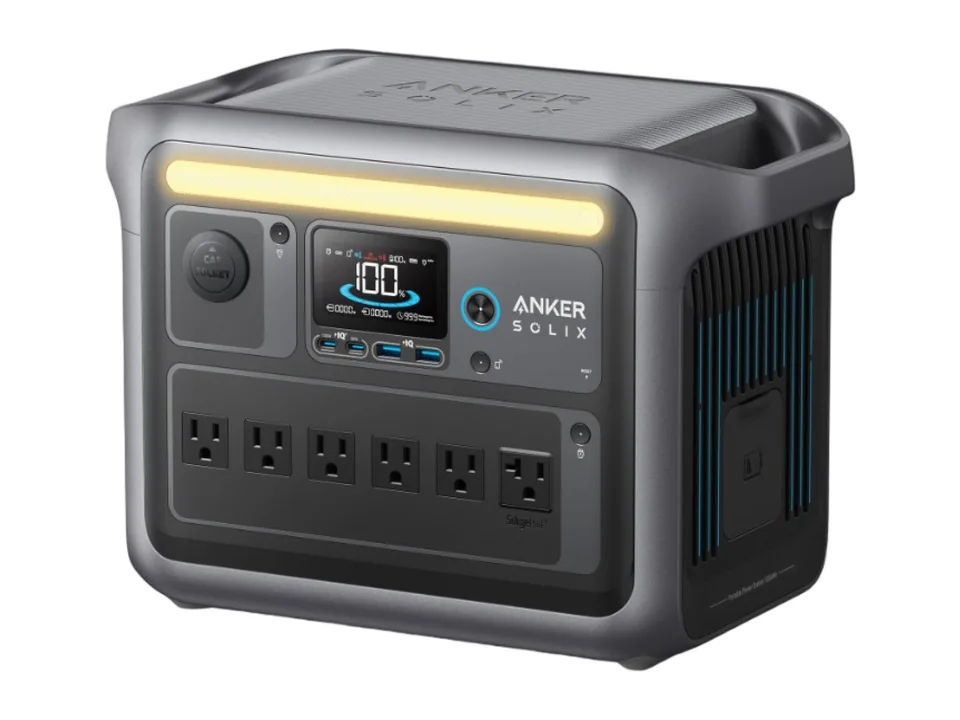
Anker SOLIX C1000 Portable Power Station
A 1,056 Wh LiFePO4 station with six AC outlets, 1,800 W of output and a full recharge in under an hour.
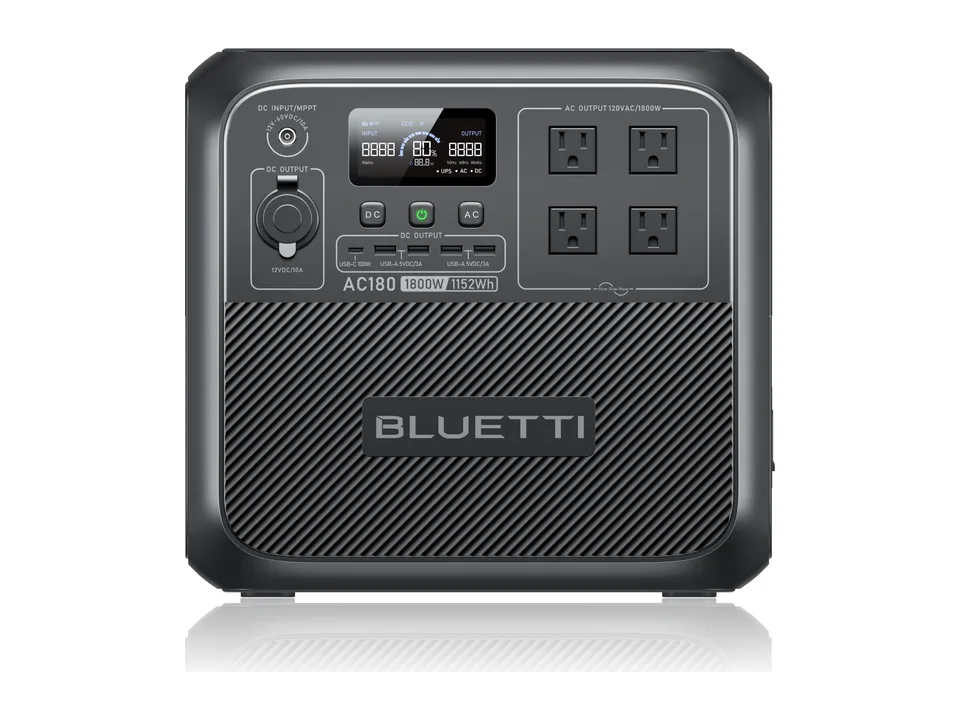
BLUETTI AC180 Portable Power Station
A 1,152 Wh LiFePO4 station with 1,800 W of AC output, cells rated for 3,500+ cycles and a wireless charging pad on top.
Side-by-side
Specs compared
| Specification | Anker SOLIX C1000 Portable Power StationOur pick | BLUETTI AC180 Portable Power Station |
|---|---|---|
| Editorial score | Editorial score:8.4/10 | Editorial score:8.2/10 |
| Best for | — | — |
| Capacity | 1,056 Wh | 1,152 Wh |
| Battery chemistry | LiFePO4 (LFP) | LiFePO4 (LFP) |
| Rated cycle life | 3,000 cycles to 80% capacity | 3,500+ cycles |
| AC output | 1,800 W | 1,800 W |
| Peak output | 2,400 W surge | 2,700 W in Power Lifting mode |
| AC outlets | 6 | 4 |
| USB-C output | 1 x 100 W, 1 x 30 W | — |
| Wall recharge | 80% in 43 minutes, full in under an hour (1,300 W input) | 0-80% in 45 minutes (1,440 W input) |
| Max solar input | 600 W | 500 W |
| Expandable to | 2,112 Wh with one expansion battery | Up to 4,224 Wh with BLUETTI B80, B230 or B300 batteries, per BLUETTI |
| Backup switchover | Under 20 ms | — |
| Weight | 28.4 lb (12.9 kg) | 35.3 lb |
| Dimensions | 14.8 x 8.1 x 10.5 in | 13.4 x 9.7 x 12.5 in |
| Warranty | 5 years | 5 years |
| Where to buy | Check Latest Price on Amazon (paid link) | Check Latest Price on Amazon (paid link) |
Scroll sideways to see both columns →
At a glance
Key differences
- 1Capacity: 1,152 Wh for the BLUETTI, 1,056 Wh for the Anker.
- 2Weight: 28.4 lb for the Anker, 35.3 lb for the BLUETTI.
- 3Wall recharge: 80% in 43 minutes for the Anker, 80% in 45 minutes for the BLUETTI.
- 4Solar input: 600 W against 500 W.
- 5Expansion: up to 4,224 Wh for the BLUETTI, 2,112 Wh for the Anker.
Product by product
Pros and cons
Anker SOLIX C1000 Portable Power Station
The most complete specification sheet in the 1 kWh class: fast charging, the most solar input and a stated switchover time. Make sure the listing you buy is the generation you want.
Pros
- Full wall recharge in under an hour, by Anker's figures
- 600 W of solar input, the highest of the 1 kWh models we cover
- Six AC outlets and a published switchover time of under 20 ms
- 5-year warranty and cells rated for 3,000 cycles
Cons
- This is the first-generation C1000: Anker now also sells a C1000 Gen 2 with different specifications
- Only one of the two USB-C ports delivers 100 W; the other is limited to 30 W
- Expansion stops at 2,112 Wh, less headroom than the EcoFlow DELTA 2
BLUETTI AC180 Portable Power Station
A little more capacity and a longer cycle rating than its rivals, in a heavier body with fewer outlets. A sound pick if it will mostly stay in one place.
Pros
- The largest capacity of the 1 kWh models we cover, at 1,152 Wh
- Cells rated for 3,500+ cycles, with a 5-year warranty
- Charges to 80% in 45 minutes from a wall outlet
- Wireless charging pad for phones on the top panel
Cons
- The heaviest in its class: BLUETTI lists 35.3 lb in its table and 37 lb elsewhere on the same page
- Four AC outlets, where the Anker SOLIX C1000 has six
- We could not find a backup switchover time on BLUETTI's product page
Choose the Anker SOLIX C1000 if
- You will carry it: 7 lb lighter is noticeable.
- You use it as backup for a computer: Anker publishes a switchover under 20 ms.
Choose the BLUETTI AC180 if
- You want the most room to expand, up to about 4.2 kWh.
- You value the slightly higher starting capacity.
What we could not confirm
BLUETTI does not publish a UPS switchover time for the AC180 on the pages we read.
Frequently asked questions
- Which is lighter, the Anker C1000 or the BLUETTI AC180?
- The Anker, at 28.4 lb against 35.3 lb.
- Which can be expanded further?
- The BLUETTI AC180, to about 4,224 Wh. The Anker C1000 reaches 2,112 Wh with one expansion battery.
- Do they have the same output?
- Both are rated for 1,800 W of continuous AC output.
More comparisons
VS comparison
Anker SOLIX C1000 Gen 2 Portable Power Station vs Anker SOLIX C1000 Portable Power Station
The Gen 2 is lighter, more powerful and longer-rated. The original C1000 keeps one advantage: it can take an expansion battery.
Updated October 15, 2026
VS comparison
EcoFlow DELTA 2 Portable Power Station vs Anker SOLIX C1000 Portable Power Station
Two of the most compared 1 kWh stations: same 1,800 W of output and LFP cells rated for 3,000 cycles. They differ in charging, solar and how far each can expand.
Updated October 15, 2026
VS comparison
EcoFlow DELTA 3 Plus Portable Power Station vs Anker SOLIX C1000 Gen 2 Portable Power Station
Both store about 1 kWh in LFP cells rated for 4,000 cycles. The Anker puts out more power and charges faster from the wall; the EcoFlow takes twice the solar and can grow to 5 kWh.
Updated October 15, 2026