Jackery Explorer 2000 v2 Portable Power Station Review
A 2,042 Wh LiFePO4 station of about 39.5 lb with 2,200 W of AC output, a 1.75-hour wall recharge and a 5-year warranty.
By Watt Versus Editorial· Updated
This page was drafted with AI assistance from manufacturers' specs and manuals, and is checked by our editor.
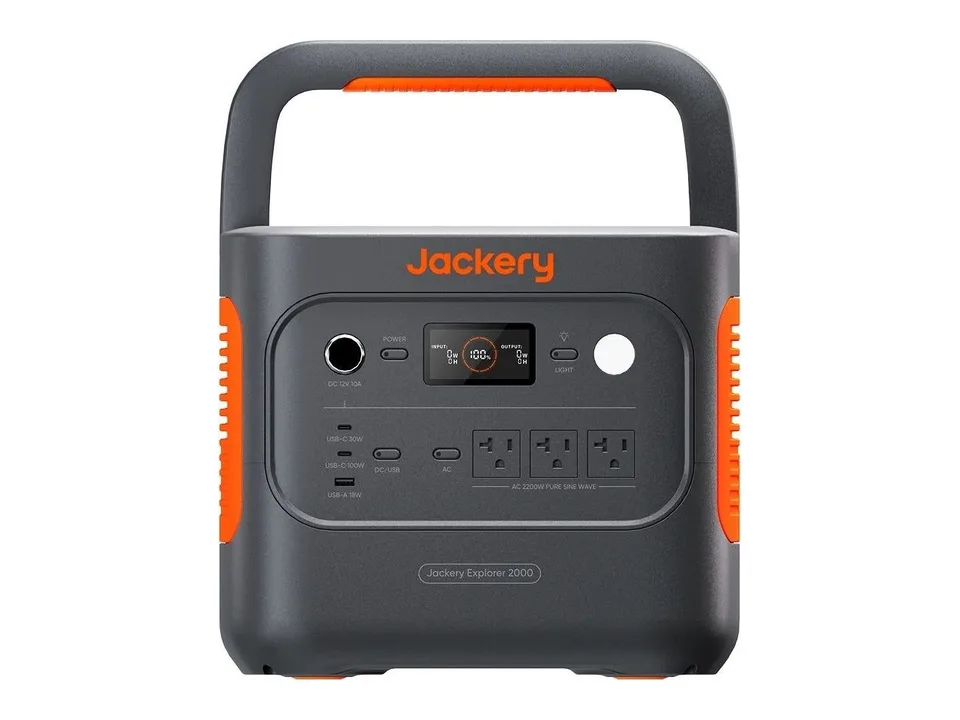
Our verdict
The 2 kWh station to buy if weight matters more than solar or expansion: about 39.5 lb with a fast wall recharge. If you want to add batteries later, the Anker SOLIX C2000 Gen 2 is barely heavier and grows to about 4 kWh.
Pros and cons
Pros
- About 39.5 lb: the lightest 2 kWh station we cover
- 4,400 W surge for motors and compressors that need a hard start
- Under 20 ms switchover for a fridge, router or desktop
- 5-year warranty, by Jackery's terms
Cons
- 400 W of solar input, against 800 to 1,200 W on other 2 kWh stations we cover
- Not expandable: 2,042 Wh is all you get
- Three AC outlets, fewer than most 2 kWh rivals
Specifications
| Capacity | 2,042 Wh |
|---|---|
| Battery chemistry | LiFePO4 (LFP) |
| Rated cycle life | 4,000 cycles to 70%+ capacity |
| AC output | 2,200 W |
| Peak output | 4,400 W surge |
| AC outlets | 3 x 120 V |
| USB-C output | 1 x 100 W, 1 x 30 W |
| Wall recharge | About 1.75 hours (1.7 hours in Jackery's feature text) |
| Max solar input | 400 W through two DC8020 ports |
| Expandable to | Not expandable, per Jackery |
| Backup switchover | Under 20 ms |
| Weight | About 39.5 lb (17.9 kg) |
| Dimensions | 13.2 x 10.4 x 11.5 in |
| Warranty | 5 years (3 + 2), per Jackery |
Who it suits
Households that want 2 kWh of outage backup they can move from the garage to the kitchen, and RV or van owners who mostly charge from the wall or the vehicle. Jackery lists 2,042 Wh of LiFePO4 cells, 2,200 W of AC output with a 4,400 W surge, an under-20 ms switchover and a weight of about 39.5 lb, which makes it the lightest 2 kWh station we cover. The closest rival on weight is the Anker SOLIX C2000 Gen 2 at 41.7 lb; see Explorer 2000 v2 vs SOLIX C2000 Gen 2.
Who should skip it
Solar-first users: two DC8020 ports take 400 W in total, where the BLUETTI AC200L takes 1,200 W. Anyone who may want more than 2 kWh later should look at the C2000 Gen 2 or the Explorer 2000 Plus, because Jackery says the 2000 v2 is not expandable. For the whole group, see the best 2 kWh power stations.
What we could not confirm
Jackery quotes both 1.7 and 1.75 hours for a full wall recharge, and a faster "emergency" mode set in its app; we show the spec-table figure. Its cycle rating is 4,000 cycles to 70% or more of capacity, a lower end point than the 80% that some rivals quote, so the numbers are not directly comparable. The 5-year warranty is written as "3+2 years" in the spec table.
Frequently asked questions
- How much does the Jackery Explorer 2000 v2 weigh?
- About 39.5 lb (17.9 kg), according to Jackery's spec table.
- Can you add a battery to the Explorer 2000 v2?
- No. Jackery says the Explorer 2000 v2 is not expandable. The expandable 2 kWh Jackery is the Explorer 2000 Plus.
- How much solar can the Explorer 2000 v2 take?
- Up to 400 W, through two DC8020 ports, by Jackery's specs.
Sources
The specifications and claims on this page come from these manufacturer documents. Figures are the manufacturers' own unless the text says otherwise.
Ready to buy the Jackery Explorer 2000 v2 Portable Power Station?
Prices change often. See the current price and availability on Amazon.
Compare and read more
VS comparison
Jackery Explorer 2000 v2 Portable Power Station vs Anker SOLIX C2000 Gen 2 Portable Power Station
The two lightest 2 kWh stations we cover: about 39.5 lb for the Jackery and 41.7 lb for the Anker. The Anker adds more output, twice the solar input, an RV outlet and expansion to about 4 kWh.
Updated October 26, 2026
Best of
Best Portable Power Stations for Home Backup (2026)
Five stations for outages, from a small UPS for your router to 2 kWh systems that expand to 8 or 12 kWh and run a fridge for days.
Updated October 26, 2026
Best of
Best 2 kWh Portable Power Stations (2026)
Seven 2 kWh LiFePO4 stations for home backup, RVs and off-grid use, picked from the makers' own specs: output, solar input, expansion and weight.
Updated October 26, 2026